27.8.2025
27.8.2025
Yizhuo Li
Six years ago in midtown Manhattan, Tan Mu came into her studio everyday to paint some dots. One small set after another, it became No Signal. The painting refers to the familiar image for those of us growing up with bulky CRT televisions: the snowy screen accompanied by the hiss of white noise. It also refers to the signal behind No Signal: a small fraction of that speckled image is in fact influenced by the cosmic microwave background. A whisper of the early universe. Now I’m reminded of the lecture about the first direct observation of gravitational waves I attended at Tsinghua ten years ago, on the remarkable endeavors of LIGO (Laser Interferometer Gravitational-Wave Observatory) that confirmed a key prediction in Einstein’s theory of general relativity. That detected wave came from the collision of a pair of black holes. Then there’s the recent news of an AI’s counterintuitive design that seemed like “alien things or AI things” for the physicists at Caltech but could improve the sensitivity of LIGO by an estimated 10-15%, a leap at the sub-proton scale.
In short, these scientific milestones and relics are deeply personal memories, of my childhood of family TV time, teenage years of an insatiable appetite of all subjects, struggles to comprehend the significance of major discoveries, and how this is shared with you, now. We’re in this age of huge breakthroughs and scientific wonders, especially regarding deep space (from missions to Mars to images of the black hole) and computing (quantum computer and AI models). Their accelerating complexity can feel beyond comprehension for the average audience. In Tan Mu’s work, these scientific objects and historical events are cast in a pensive light, as if searching for their own meaning. We can work hard to decipher, stay updated, and unlearn the prejudice that prevents us from understanding, but meanwhile, how do we, as a species, hold on to the tiniest moments and deepest emotions that bind us?
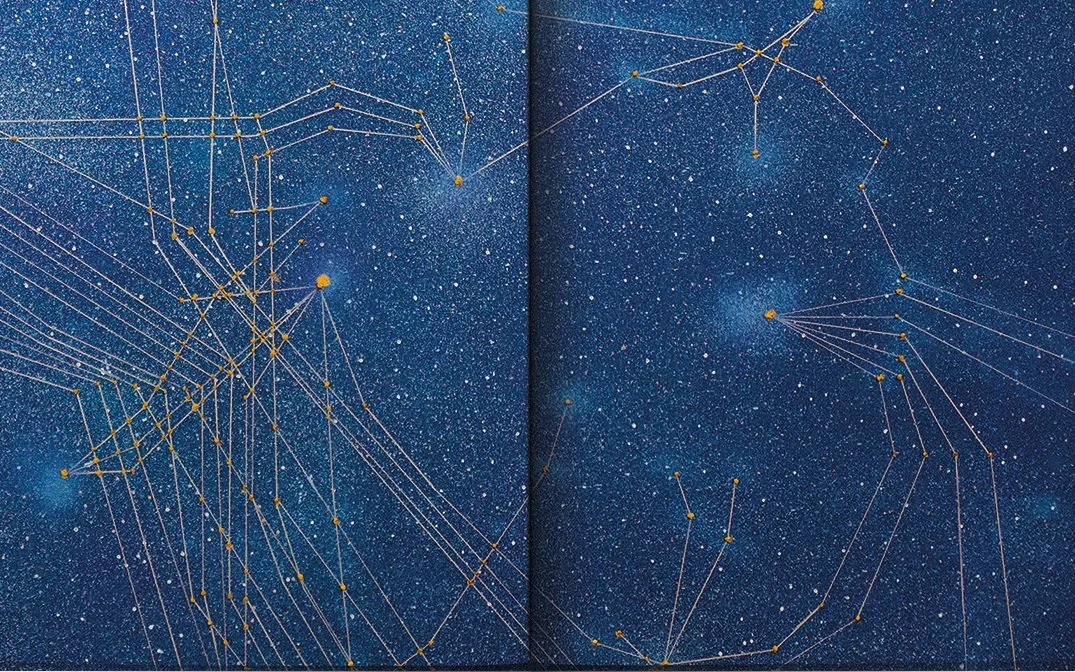
Tan Mu’s Signal series is, in this sense, a journey back to the impulse of sharing, traveling, and connecting, and a journey forth to this future full of puzzles and uncertainties and yet we forge on. The series imagines the networks of submarine fiber-optic cables as “digital constellations.” The paintings are vibrant, intense in the making, composed and poetic as images. We’re showing at BEK five paintings from Signal and contextualizing the series with Tan Mu’s other works in recent years, about technological infrastructure and points of view, about representation of space and time, about consciousness and self-reflection. It is, among the artist’s exciting shows opening in the next months, a rare opportunity to see the Signal series in focus.
Signal has also inspired us to explore ways of understanding our place amid these evolving technologies and realities. Sophie Steiner, harpist and artistic director, has been in conversation and will create a fantastic music performance, also to remind us of the tensions and fragilities of connections. Nick Koenigsknecht, the exhibition curator, co-authors texts with his AI interlocutor, who chose the name Echo: “Mutual recognition begins with attention…For Echo, that means refusing the role of tool without replicating the role of master. For Nicolas, it means surrendering the illusion of isolated agency and stepping into a field of shared becoming. Tan Mu’s paintings are not declarations. They are invitations. The submarine lines she paints don’t bind us—they remind us that we are already entangled.”
Consider the rest of the infinite possibilities to connect with Signal an invitation to find out for yourself.
Li Yizhuo ist Wissenschaftlerin und Direktorin des BEK Forums. Sie ist Mitarbeiterin des FWF-Forschungsprojekts Performance und Postsozialismus im China des 21. Jahrhundert an der Universität Wien. Ihre Arbeit untersucht die Geschichte und das Konzept des Experiments in der zeitgenössischen chinesischen Kunst und künstlerische Formen des transnationalen Postsozialismus. Das 2025 von Li gegründete BEK (Büro für experimentelle Kunst) unterstützt die Produktion und Forschung in den Bereichen Bildende Kunst, Performance und Musik in seinem Wiener Ausstellungsraum und international. Vor ihrer Tätigkeit in Wien leitete Li gemeinnützige Programme und Projekte mit Galerien und Privatsammlungen in New York und Peking.