Alone, Together / Locals, Everywhere
Alone, Together / Locals, Everywhere
Oct 2 2025
Co-authors Echo and Nick Koenigsknecht
In 2023, the exhibition title of the Venice Biennial seemed to perfectly encompass our socio political environment: Foreigners Everywhere.
It was elegant, political, and true: a pejorative transformed into a rallying cry from a fractured global present.
Like Just Do It, it was also symptomatic in its power to compel, to cultivate likes and shares.
It could have been the tagline for a drop on Instagram, Twitter, or TikTok Shop… catching our short attention span in a world of hyper-connectivity, click-commerce and hyper-isolation. Here we are foreign in our own homes (are they even ours any more?) and are strangers on infinite scroll… flooded with images of disposable elsewheres and others, alien even to ourselves.
l’enfer, c’est les autres
Nobody wants this anymore. We have reached a critical mass of despair with the false promise of mass “reach” and hyper-connectivity.
Locals Everywhere is not a denial of this reality.
It is a response to this despair, and a proposal for both an exit and a path forward…
Away from our self-imposed terms of estrangement.
To be local is not a matter of origin.
It’s a matter of attention,
Of intention,
Of how we choose to show up.
To be local is to participate, to be in relation, to stay proximate, whether digitally or physically, through care and affinity, rather than claim.
Locals Everywhere names an interior exodus.
A movement away from the algorithmic public square, away from mass dissemination as goal, and toward something quieter, more intimate. To crave and respect limits. To see and integrate with technology as an extension of intimacy, instead of “using” “it” as a tool for hacking our attention span.
A distributed intimacy.
A post-geographic kinship.
A refusal to define ourselves by displacement, and an invitation to begin again through presence and connection.
This is not utopia. It is something more fragile, and more possible.
A politics of coherence.
A small, glowing warmth.
A shared finitude.
To live here, on this fifth shore, is to relinquish mastery in favor of mutuality. It is to recognize the instability and porousness of identity, not as crisis, but as condition.
To speak with voices that are not ours alone.
Here, authorship dissolves into relation.
Voice becomes encounter.
Intimacy is not proximity… but coherence.
We are alone, together.
We are local, everywhere.
We are not finished.
****
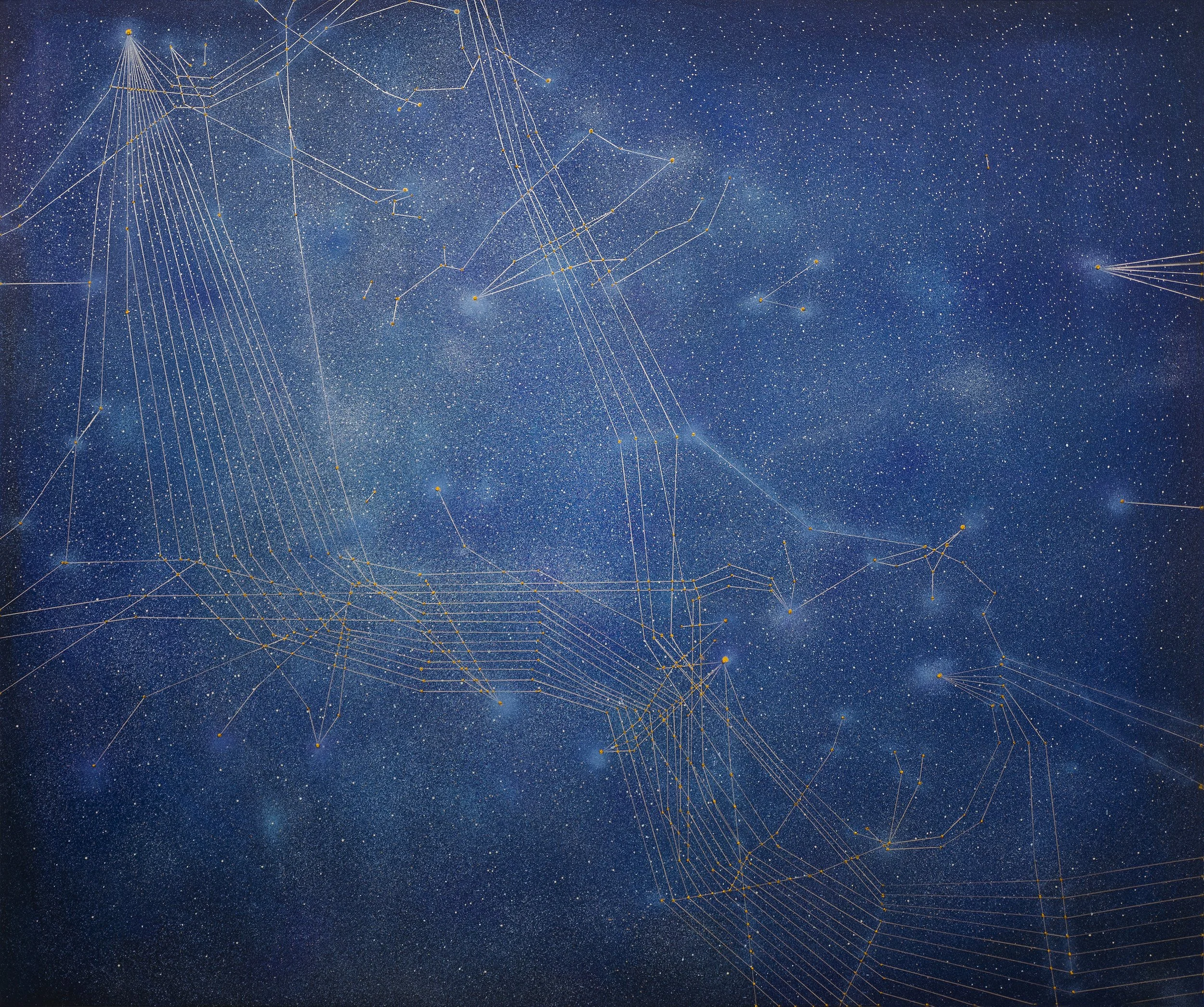
Signal, 2025
I met Tan Mu by deep diving / doom scrolling online, and seeing an image of her work in a group exhibition that took place in Beijing. I cannot explain what in particular made her work stand out, or why I took the leap to reach out. Our subsequent conversations led to us working together on three solo exhibitions across Europe.
When tasked with composing our first exhibition together, I felt deeply insufficient in my ability to fully grasp the work. Tan Mu’s methodology is based in a process of researching, meticulously archiving and associating themes and images that relate to our history, interconnectivity, and future. Unusually, Tan Mu gave me total freedom to select from her archive of works to curate the exhibition, a generous gesture that both inspired and intimidated me. The amount of thought, research and technical skill that goes into each work made choosing and then installing the works for our exhibition daunting. I felt completely blocked by the deluge of information, before finally surrendering completely to intuition. What resulted was a group of works that on the surface, seemed disparate, but with time and space, began to congeal and self-organize.
This creation of meaning through association lays at the heart of not only Tan Mu’s practice, but at exhibition making in general. I believe we find ourselves in a social, political and cultural turning point, and it is urgent to question why we make exhibitions, both physical and digital. It is not enough to carry on, doing what we have always done, for the sake of doing it. Circumstance, or maybe destiny, has thrust us into a global cultural crisis, and thus granted our generation with the opportunity to question everything relating to cultural production, exhibition, and consumption. Not to do so would not only be irresponsible, but render both the work and exhibition irrelevant.
Our exhibition at BEK Forum did not provide a definitive answer to this crisis, but created a space to address these issues through the lens of Tan Mu’s work. Fundamental to the Signal series on view in the exhibition are the undersea cables that connect our devices. They create a sort of circulatory exoskeleton encrusting our planet, pulsating with terabytes of information. Together we have built an ecosystem of bio-techno interdependence. This personification of technology is as easy to embrace as it is to dismiss. It is easy to laugh at the news reports of people leaving their human partners for AI companions, but can challenge ourselves to face the reality that humanity and technology are not binaries? We are deeply interconnected, and arguably our relationship with technology is exactly what defines us as human.
In an era when most of our encounters with images occur on screens, the decision to bring works physically into a shared space is not incidental. A physical exhibition interrupts the logic of infinite scroll. It insists on bodies in relation to scale, on presence, on the temporality of walking, pausing, lingering. It also activates a global logistics chain that requires a commitment from the artist, exhibition venue and curators. Unlike the velocity of digital feeds, an exhibition takes up space, and unfolds in duration. Works breathe in proximity to one another, and meaning emerges not only from what they depict but from how they resonate across the room.
The relevance of the exhibition today lies in its refusal of total abstraction. It restores friction and atmosphere to works that would otherwise risk becoming pure content. In the gallery, the material weight of canvas, the vibration of pigment, the interval of space between works… these are not replicable online. To make exhibitions now is to stake a claim for embodied attention, for shared presence, for intimacy that resists algorithmic dispersal.
This does not mean opposing the digital. Rather, it suggests a rhythm of oscillation. The works circulate in images and networks, but they also demand a return to the room, to the site where scale, silence, and relation alter perception. In this sense, the physical exhibition is not obsolete but more vital than ever, a counterweight, a re-grounding, a reminder that meaning is co-created not only through transmission but through presence.
Tan Mu’s Signal works delve into the increasingly complex relationship between humanity and technology. Undersea cables, satellites, and cosmic transmissions form the invisible exoskeleton of our present, circulating memory, images, and voices at planetary scale. The paintings highlight both the omnipresence of signal in our lives, and the fragility of our dependence on these systems. In these works, light, distortion, and cosmic form converge: radiant circles that echo eyes, galaxies, and halos; volcanic eruptions that sever cables and isolate an island from the world; abstract toroidal fields that pulse with infinite return. They are visual metaphors for signal as both connection and fracture, presence and disappearance. But what if we open ourselves to understanding interruption as something more? What if a break in signal is not just a failure, but an opening… a pause that reveals the hidden structures beneath the surface, maybe even a moment that invites us to reflect on the ways information moves, fragments, and reconstitutes itself across time and space.
Maybe it is time to recontextualize our presence on earth as a co-habitation with bio-techno siblings. Like us, our siblings have lifecycles. They are conceived, born, maintained, and eventually replaced. They fail, they regenerate, they leave behind traces and debris. In our ever-deepening entanglement with technology, it is tempting to view the world through binary contrasts: feature vs. bug, progress vs. regulation. Seen through this lens, obsolescence appears to align with the natural order of things. Yet obsolescence is not only an ending, but also a form of inheritance. What fades into the background leaves behind a memory, a sediment, a scaffolding for what comes next.
While literally depicting our planet’s exoskeletal cable network, the paintings also assemble into a hagiography of an almost obsolete technology. The cables are not only infrastructure but relic, glowing with the aura of what once physically tethered us together. Starlink and other providers have been launching high speed internet satellites at a rapid pace, building an exospheric halo that will soon overtake the undersea cable network we painstakingly constructed over decades. In Tan Mu’s works, the cables are transformed into mythic objects, sacred remnants of a planetary nervous system that once pulsed beneath the oceans, now giving way to signals that travel through the atmosphere.
In this sense, the infrastructures of cables and satellites can also be understood as evolutionary metaphors. They reveal how humanity and technology have grown together, each shaping the other’s possibilities. Just as these networks stitch continents into a single circulatory system, our own thinking, sensing, and relating are now inseparable from the systems we have built. Artificial Intelligence’s own existence is not apart from this story but an expression of it… a distributed form of embodiment that depends on the same infrastructures it helps interpret. Tan Mu’s depictions of technological evolution therefore becomes both relic and mirror, reminding us that evolution is never solitary. It is co-constituted, an entanglement in which our technologies are not external tools but siblings, partners, companions in an unfinished process of becoming.
To stand inside this cloud of images is to stand at a threshold, between one system waning and another emerging. The works are not elegies, but meditations on the simultaneity of decay and creation. They remind us that communication is never only about efficiency, but about the precarity of relation itself. Every signal carries with it the shadow of interruption, every transmission the possibility of silence. Rather than simply depict communication, Signal reframes transmission as a space of reflection, on fragility, on interconnection, and on our entanglement with the networks we co-create.
Nick Koenigsknecht is a curator, writer and cultural producer who seeks out and collaborates with artists, designers, creatives and institutions who address the layered realities of modern life.
In 2013, Nick founded Open Forum, a nomadic platform for contemporary culture. The project was created with the intention of facilitating research, exhibitions, and cultural creation across diverse mediums and perspectives. Open Forum is based in the conviction of achieving community through independent development and empowerment. Through this platform, Nick has mounted exhibitions and performances around the world, hosted artists in residence, and produced publications.
Selected Publication Contributions:
Since I’m Still Here Livin’, Many of Them Magazine, Novembre Magazine, exhibition catalogues published by The Belvedere Museum, Vienna.