Glaciers as Memory, Painting as Witness
Strata of Time: Glaciers as Information Structures
“If you want to know what happened on Earth 100,000 years ago, you ask the ice.” Tan Mu responds to this scientific axiom through a rigorous painterly inquiry that redefines the medium as a vessel for geological temporality. In this body of work, her glacier series extends a structural visual language to investigate the ways in which natural systems store and release information across vast timescales. These formations function as planetary memory devices or silent archives where atmospheric sediment and deep time are compressed into frozen strata.
The canvases frequently echo the morphology of ice cores, translating the act of scientific sampling into luminous and highly layered surfaces. Each mark on the surface evokes the presence of air bubbles, ash, and isotopes, transforming materials that are typically decoded in laboratories into painterly systems of sedimented time. Tan Mu eschews the traditions of realistic landscape in favor of a multi-dimensional interface, presenting glaciers as unstable infrastructures of memory and embedded data.
Throughout the series, neural branches and circuit-like fissures recur to evoke both biological signal paths and the stratified Earth, bridging the gap between micro-particle textures and planetary scale. Her process mirrors the logic of scientific accumulation and delay while refusing definitive resolution, allowing the emotional temperature of the work to emerge as something slow and precisely calibrated. In this context, the glacier is no longer a mere symbol of climatic change but an instrument for perceiving the very architecture of time.
Territory in Retreat
This site does not offer certainty.
The Arctic appears vast and continuous, yet it is composed of surfaces in slow retreat. What seems fixed is already changing. Scale, distance, and orientation remain unstable, resisting overview.
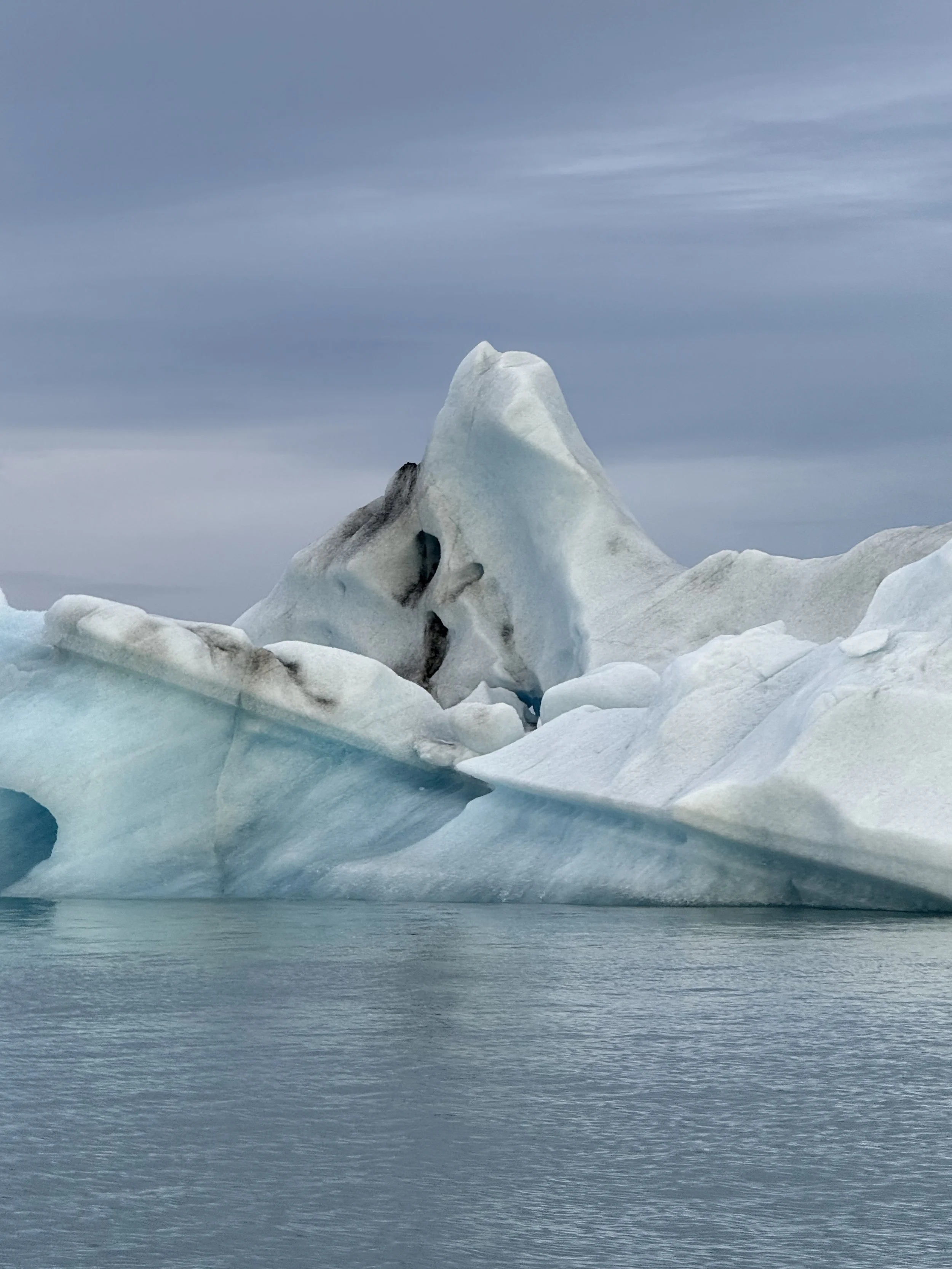
Rendered with hyper-realistic precision, Tan Mu’s glacier paintings depict ice in states of collapse and melt, their surfaces closely observed rather than dramatized.
In this context, painting becomes a modest form of truth. Not as a declaration, and not as proof, but as attention. The paintings do not explain the glacier, nor do they attempt to stabilize it. They hold fragments of surface, moments of contact, brought into focus through time, labor, and looking.
Scientific research is foundational to this practice. Glaciological study, environmental measurement, and sustained field observation establish the conditions from which the paintings emerge. Data on ice movement, surface change, temperature, and melt rates inform decisions of scale, duration, and proximity, structuring the work long before image-making begins. Research here is not illustrative, nor supplementary, but constitutive, providing a temporal and methodological framework that grounds the paintings in long-term observation. Archival processes extend this framework forward, allowing both scientific data and painted surfaces to function as records of change that can be revisited, compared, and reinterpreted over time.
Unexpectedly floating above the Arctic landscape, the paintings hover in a circular formation, the works acknowledging an imbalance they cannot resolve. The environment exceeds the image. The glacier exceeds the frame. What remains is not representation, but proximity… a quiet, temporary alignment between painting, place, and perception
Paintings create cultural permanence, a brief suspension of inevitable change.
Tan Mu’s practice spans multiple fields of technological and human inquiry, integrating painting with research-driven engagement across science, engineering, material studies, and systems of observation. Her work moves fluidly between analog and computational processes, long-duration fieldwork and studio-based production, drawing equally from scientific methodology and artistic intuition. Rather than treating technology as subject or tool alone, she approaches it as a mode of inquiry, allowing different forms of knowledge, visual, technical, and experiential, to inform one another. This interdisciplinary orientation situates her work within a broader continuum of human efforts to understand, measure, and respond to complex environments over time.